
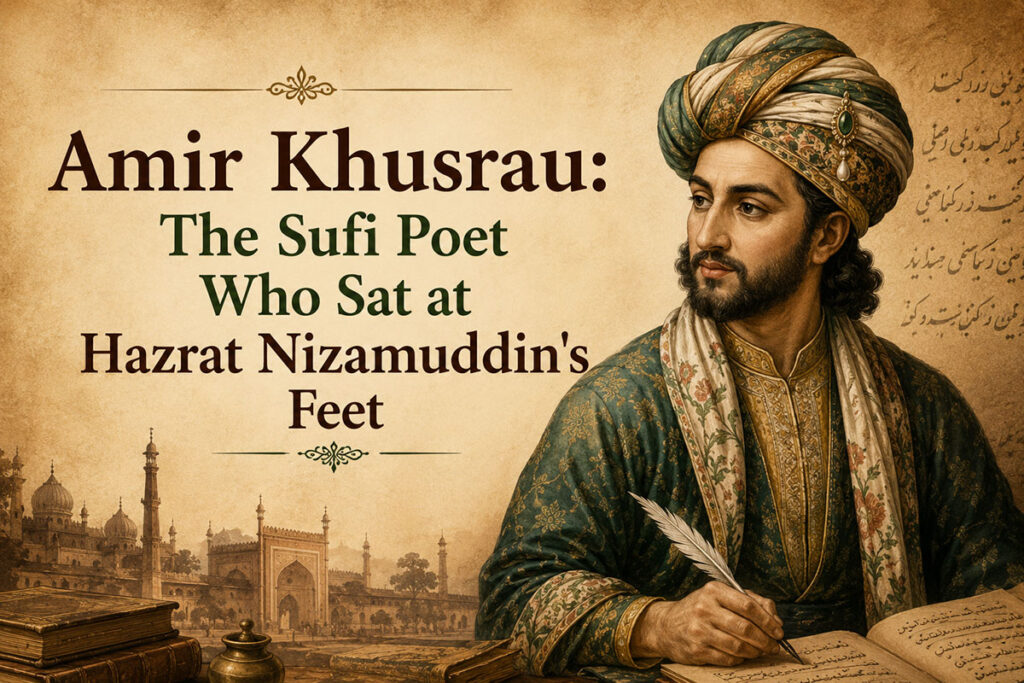
Who Was Amir Khusrau (R)?
In any honest accounting of the figures who shaped South Asian civilisation, Amir Khusrau (R) — born Abul Hasan Yaminuddin Khusrau in 1253 CE in Patiyali, near Etah in Uttar Pradesh — ranks among the most extraordinary. He was simultaneously the greatest poet of the Persian language produced by the Indian subcontinent, a pioneering figure in the development of what would become Urdu and Hindi literature, a musical innovator credited with transforming the musical landscape of northern India, a devoted Sufi who sat for decades at the feet of Hazrat Nizamuddin Aulia (R), and a court poet who served five successive Delhi Sultans while maintaining that his only true king was his spiritual master.
His Origins: A Turkish Father, An Indian Mother
Khusrau’s father, Amir Saifuddin Mahmud, was a Turkish nobleman who had come to India as part of the wave of Central Asian migration. His mother was the daughter of an Indian Muslim noble — a Rajput convert whose family had embraced Islam generations earlier.
This dual heritage — Central Asian Turkish father, Indian mother — shaped Khusrau’s entire artistic identity. He was genuinely bicultural in a way that few people in any era achieve, fluent and innovative in both the Persian literary tradition he inherited from his father’s world and the Indian musical and poetic traditions he absorbed from his mother’s. This fusion produced something that belonged entirely to neither world and yet spoke to both — the cultural DNA of what we now call Hindustani civilisation.
His Spiritual Bond with Hazrat Nizamuddin Aulia (R)
Khusrau first encountered Hazrat Nizamuddin Aulia (R) around 1272 CE, when he was approximately twenty years old. He became a murid — a devoted disciple — and the relationship that developed over the next half century between master and disciple is one of the great love stories of spiritual history.
This was not the cautious, respectful relationship of student and teacher. It was a consuming, transformative attachment in which Khusrau described his master as his king, his life, his whole world — and Hazrat Nizamuddin reciprocated with a tenderness and fondness that was notably open even by his characteristically warm standards.
The qawwali tradition that Khusrau developed was created entirely for and within this relationship. The compositions were gifts to his master. The music was the medium through which he expressed what had no other expression: a love too total for prose, a devotion too overwhelming for ordinary poetry.
Literary Contributions: Persian, Urdu, and Braj Bhasha
Persian Poetry: The Five Masnavis
In Persian literature, Khusrau’s most monumental achievement is the Khamsa — the Five Long Poems — written in conscious response to the Khamsa of the Persian master Nizami Ganjavi. These five masnavis represent a sustained achievement of narrative poetry that has few equals in any language. Beyond the Khamsa, his Persian ghazals and other lyric poems number in the tens of thousands.
The Pioneer of Urdu and Hindi Literature
Khusrau is widely regarded as one of the foundational figures of what became Urdu literature. He wrote in a linguistic blend of Persian and the vernacular Hindi of his time that represents the earliest known example of what would evolve over the centuries into the Urdu literary tradition. His most famous Hindi verse, the doha beginning “Khusrau daria prem ka…” remains among the most recited couplets in South Asian spiritual culture.
Musical Innovations That Changed India Forever
Khusrau is credited in various historical sources with the development or transformation of several instruments: most significantly the tabla (through the division of the pakhawaj drum) and significant innovations in what became the sitar. Whether these attributions are precisely accurate or represent the natural cultural phenomenon of crediting a beloved figure with innovations that happened in his milieu, the result is that Khusrau’s name is inseparably associated with the foundation of Hindustani classical music.
More firmly documented is his role in shaping qawwali as a formalised musical form: the structure of the composition, the call-and-response patterns between the lead singer and the chorus, the use of accelerating rhythm to build devotional intensity, and the practice of singing compositions in multiple languages simultaneously.
Famous Verses and Couplets with Translations
On longing (Persian ghazal): “I am intoxicated with the wine of love, what need have I of intellect? I am the moth; I have set myself on fire — what need have I of another lamp?”
On the nature of the spiritual path (Hindi doha): “Prem prem sab koi kahe, prem na jaane koi — Jo prem jaane so kahaan jaaye, jaaye to simte soi.” (Everyone speaks of love, but no one truly knows love — the one who knows love, where does she go? She who goes is absorbed entirely.)
On his master (Hindi): “Gori soye sej par, mukh par dale kes — Chal Khusrau ghar apne, rain bhayi chahu des.” — Read as Khusrau’s lament after his master’s death: the saint has gone, the world has grown dark.
The Legend of Their Deaths: Six Months Apart
Hazrat Nizamuddin Aulia (R) died on 3 April 1325 CE. Amir Khusrau (R) was away from Delhi at the time. When the news reached him, he returned to Delhi, shaved his head in mourning, dressed entirely in black, distributed all his wealth to the poor, and spent his remaining days at his master’s tomb.
Six months later — in the autumn of 1325 CE — Khusrau died. He was buried, by his own request, at his master’s feet in the Nizamuddin complex. Their tombs remain there today: the master’s in the inner sanctum, the disciple’s just outside, their physical proximity in death mirroring the inseparable spiritual bond of their lives.
Frequently Asked Questions
Q: Did Amir Khusrau (R) invent the tabla?
Historical evidence on this question is genuinely complex. Various traditional sources attribute the tabla’s development to Khusrau, specifically the division of the pakhawaj drum into two separate drums. Modern musicologists are divided. What is beyond dispute is Khusrau’s profound influence on the musical culture within which these instruments developed.
Q: What language did Amir Khusrau (R) write in?
Khusrau wrote with remarkable fluency in multiple languages: Persian (his primary literary language for major works), the early vernacular Hindi of Delhi, Braj Bhasha, and occasionally Arabic. His practice of mixing languages within single compositions was itself an innovation that became characteristic of qawwali.
Q: Where is Amir Khusrau(R) buried?
He is buried at the Nizamuddin Dargah complex in New Delhi, at the feet of his spiritual master Hazrat Nizamuddin Aulia (R). His tomb is clearly marked within the complex and is visited by devotees daily.
Q: What is Amir Khusrau’s (R) most famous composition?
It is difficult to choose from a body of work so rich and varied. Among the most universally beloved are Chhaap Tilak Sab Cheeni, Man Kunto Maula, and Aaj Rang Hai — all central to the qawwali repertoire. His Hindi doha Khusrau Daria Prem Ka remains one of the most quoted spiritual verses in South Asia.