
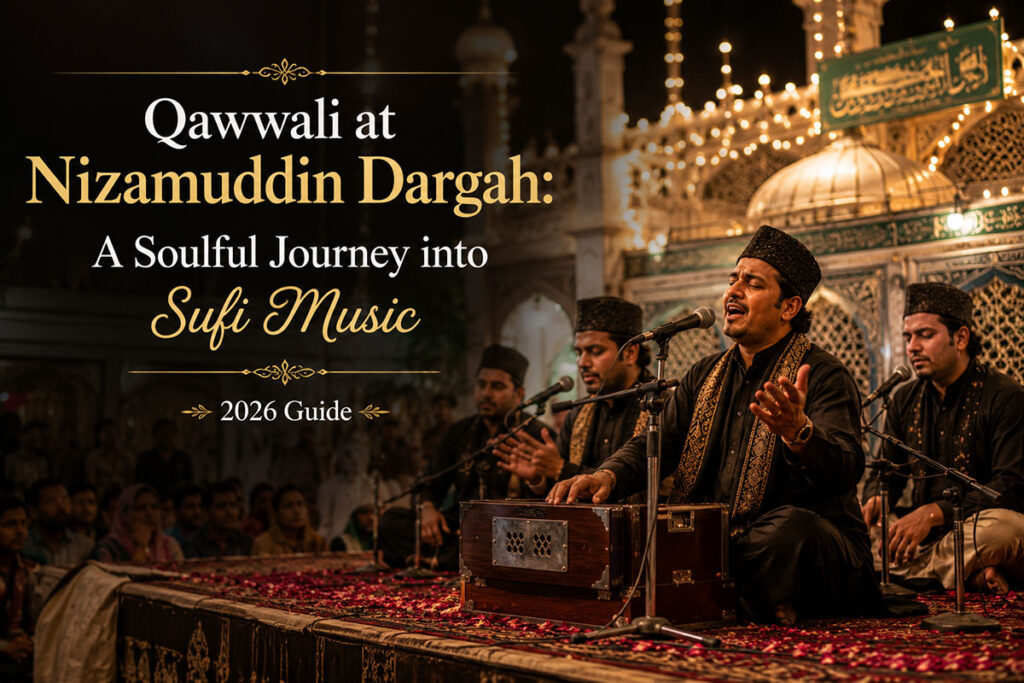
What is Qawwali? Origins and Spiritual Significance
There are few musical experiences in the world that carry the weight of centuries and the urgency of the present simultaneously. Qawwali is one of them.
The word qawwali derives from the Arabic qawl — meaning “utterance” or “word.” It refers specifically to the devotional music of the Sufi tradition: compositions in Persian, Urdu, Hindi, Punjabi, and Braj Bhasha that celebrate divine love, the beauty of the Prophet, the glory of the saints, and the soul’s yearning for union with the Beloved. It is simultaneously theology, poetry, and music — three forms that the Sufi masters understood as three expressions of a single reality.
Qawwali is distinguished from ordinary music by its purpose and context. It is performed as sama — sacred listening — within the framework of a spiritual gathering. Its goal is not entertainment but hal: a state of spiritual absorption, sometimes approaching ecstasy, in which the boundaries between self and the Divine become porous.
The Historical Origins of Qawwali
The roots of qawwali as a formalised musical tradition lie precisely here, at the Nizamuddin Dargah, in the relationship between Hazrat Nizamuddin Aulia (R) and his most extraordinary disciple: Amir Khusrau. While devotional music predated both of them, it was Khusrau who synthesised Persian Sufi poetry with Indian melodic forms, who brought the tabla into the ensemble, who invented the distinctively call-and-response structure of the qawwali composition, and who created the body of compositions that remain central to the qawwali repertoire seven centuries later.
The first qawwali assemblies in the tradition we recognise today were held in the courtyard of Hazrat Nizamuddin’s khanqah. The master himself was moved to tears by the music — a testimony, in the Sufi understanding, to its spiritual authenticity.
Thursday Qawwali at Nizamuddin: Why Thursday?
The Thursday evening qawwali at Nizamuddin Dargah is not an occasional event or a tourist performance — it is a weekly observance that has continued, with only wartime interruptions, for approximately seven centuries. Thursday is sacred in the Sufi calendar: it is the eve of the holiest day (Friday, the day of Jumu’ah prayer), and it is traditionally the night when the spirit of the saint is believed to be most powerfully present at his shrine.
The sessions begin after Maghrib prayer (the prayer at sunset, which varies between approximately 6:00 PM in winter and 8:00 PM in summer) and typically continue for two to three hours. On special Thursdays — during the Urs season, on the Prophet’s birthday, on the eve of major Islamic festivals — the sessions are longer and more elaborate.
The Hereditary Qawwals of Nizamuddin
The qawwals who perform at Nizamuddin Dargah are not randomly selected musicians. They come from a small number of hereditary families — the saff-e-qawwalan — who have served this shrine for generations, in some cases tracing their lineage of service back centuries. This hereditary connection is taken seriously: it represents not merely a professional claim but a spiritual inheritance, a transmission of the right and the responsibility to carry the music of Khusrau in the presence of the saint.
Several of these families have produced internationally celebrated artists. The late Nusrat Fateh Ali Khan — widely considered the greatest qawwali singer of the twentieth century — came from a hereditary qawwali family in the Punjabi Chishti tradition closely related to Nizamuddin’s lineage. His nephew Rahat Fateh Ali Khan continues this tradition today.
Amir Khusrau’s Compositions: The Core Repertoire
Any qawwali session at Nizamuddin will include compositions attributed to Amir Khusrau. Among the most beloved: Chhaap Tilak Sab Cheeni — a masterpiece of longing in which the lover surrenders every attribute of identity to the Beloved. Man Kunto Maula — proclaiming devotion to the saint in a composition that moves between Arabic, Persian, and Hindi with breathtaking fluency. Nit Khair Manga — a dawn prayer of heartbreaking beauty. Aaj Rang Hai — a composition of ecstatic celebration traditionally sung at the Urs.
These are not museum pieces. They are living prayers, performed with the same devotional intensity today that they were composed with seven centuries ago. Hearing them sung in this courtyard, with the tomb of their composer twenty metres away, is an experience that has no adequate description in prose.
How to Experience Qawwali as a First-Time Visitor
Practical Preparation
Arrive before sunset on a Thursday — ideally by 6:30–7:00 PM in winter or 7:30–8:00 PM in summer. Make your way to the main courtyard of the dargah. No ticket, no reservation, no invitation is required — you simply arrive, find a position in the courtyard, and sit.
Dress modestly and cover your head. Bring a small cushion or be prepared to sit on the marble floor — the sessions are long and the floor becomes hard. Silence your phone completely.
What You Will Experience
The session begins quietly — a few singers warming up, the tabla and harmonium players testing their instruments. Then the first composition begins, softly. Over the course of the next two to three hours, the intensity builds and releases in waves. You do not need to understand the words to be moved by qawwali — though reading translations of key compositions before attending enriches the experience considerably.
Frequently Asked Questions
Q: What time does qawwali start at Nizamuddin Dargah?
The Thursday evening qawwali begins after Maghrib prayer (sunset prayer). This means approximately 6:00–6:30 PM in winter (November–February) and 7:30–8:00 PM in summer (May–August). Check the local sunset time for the specific date of your visit. Sessions typically continue for two to three hours.
Q: Is there an entry fee for the Thursday qawwali?
No. The Thursday qawwali at Nizamuddin Dargah is free to attend. There is no ticket, no reservation, and no entry fee. Small donations to the dargah committee or to the qawwali performers are welcomed and appreciated, but entirely voluntary.
Q: Can women attend the Thursday qawwali at Nizamuddin?
Yes, women can attend the Thursday qawwali. They typically sit in a separate section of the courtyard from men, in line with the dargah’s customary arrangements. Women should be modestly dressed with covered heads.
Q: What is the best qawwali to listen to before visiting Nizamuddin?
Begin with Amir Khusrau’s compositions: Chhaap Tilak Sab Cheeni, Man Kunto Maula, and Aaj Rang Hai in recordings by Nusrat Fateh Ali Khan. These compositions are central to every Nizamuddin qawwali session and hearing them in advance will deepen your experience of the live performance enormously.